Markets, late tables and the part of Amsterdam that moves faster.
De Pijp was built in the late nineteenth century as Amsterdam expanded beyond the canal ring, and that newer shape still defines it. The streets are wider, the pace is quicker, and much of the neighbourhood’s life happens at street level, around Albert Cuyp Market, small cafés, wine bars and some of the city’s strongest places to eat. It feels younger than the Jordaan and less composed than the Canal Belt, but that is part of its appeal. If you are looking for hotels in De Pijp Amsterdam, these are the stays that place you closest to the neighbourhood’s energy, food and daily rhythm.
Jordaan
Canals, quieter streets and a slower local rhythm
Museum Quarter
Leafier streets, grand museums and a calmer pace
De Pijp holds onto a kind of looseness that other parts of Amsterdam have lost. The streets stay active from morning through late evening, terraces spill naturally into the pavement, and much of the neighbourhood is stitched together by food, cafés and the market at its centre. It feels less arranged than the Canal Belt and less inward than the Jordaan, which gives it a different kind of energy. If you want a part of Amsterdam that feels local, social and easy to step into, De Pijp is one of the city’s stronger places to stay.
These are the De Pijp hotels we would stay in for the neighbourhood itself, close to the market, the cafés, and the part of Amsterdam that feels most switched on.
Sir Albert sits where De Pijp is most useful: by the market, close to the museums, and within easy reach of some of the city’s strongest tables.
Set on Albert Cuypstraat, Sir Albert keeps the industrial shape of its former diamond factory intact. High ceilings and tall factory windows give the rooms more light and scale than most city hotels, while the interiors stay clean and restrained. What makes it work is the position. Albert Cuyp Market starts at the door, strong restaurants sit within a few streets, and Museumplein is still an easy walk. Izakaya downstairs keeps the building tied to the neighbourhood.
Food-led stays, first visits to Amsterdam, and travellers who want De Pijp at their doorstep.
Pestana trades De Pijp’s tighter streets for the Amstel, which changes the stay immediately.
Set inside two restored nineteenth-century civic buildings on the Amstel, Pestana brings a different scale to De Pijp. The Neo-Renaissance façade, formal staircases and high ceilings give the building more weight than most city hotels, while the river shifts the atmosphere completely. De Pijp’s cafés, restaurants and Albert Cuyp Market stay within walking distance, but returning along the Amstel changes the pace of the stay. The spa and pool make that separation feel deliberate.
Longer stays, quieter weekends, and travellers who want De Pijp close but the Amstel closer.
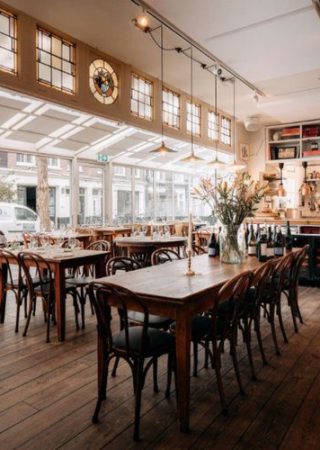
Set on Frans Halsstraat, one of De Pijp’s better streets, Café Caron feels rooted in the neighbourhood rather than styled for it. The Caron family runs it like a proper French bistro: seasonal cooking, a short menu that shifts often, and a cellar built around Burgundy. In a part of Amsterdam shaped by cafés, terraces and good places to eat, it is one of the tables that helps define the street.
De Pijp and the Jordaan offer two very different ways to stay in Amsterdam. De Pijp feels looser, younger and more social, built around markets, terraces and some of the city’s strongest places to eat. The Jordaan is older and quieter, shaped by canals, smaller streets and a stronger sense of residential life. If food and movement matter more, De Pijp makes the stronger case. If you want a slower pace and a neighbourhood that feels closer to Amsterdam’s older structure, the Jordaan holds its ground better.
Jordaan
Canals, quieter streets and a slower local rhythm
Canal Belt
Wider canals, taller houses and Amsterdam at its most composed
Museum Quarter
Leafier streets, cultural landmarks and a calmer part of the city
Our perspective
For collaborations and enquiries
We use cookies to improve your experience and understand how the site is used. You can accept or manage your preferences at any time.