Buildings that still carry traces of their original life.
London has always been good at repurposing buildings that were built to last. A Gothic railway hotel that poets campaigned to save from demolition. A Midland Bank where 850 people now eat dinner in the old banking hall. A magistrates court where the jail cells became guest rooms. The best heritage hotels in London work because the original building is still doing most of the work, and the stay feels like proof of it.
Cool Hotels
Design-led stays with a contemporary edge
Quiet Hotels
Calmer stays and a slower pace
Soho
Restaurants, music and central London after dark
The difference with a heritage hotel is felt before you reach the room. In the weight of the staircase, the height of the ceiling, the proportions of a building that was designed for something else entirely. London has more of these than most cities, buildings that survived demolition campaigns, wartime bombing and decades of neglect before someone saw what they were worth. What remains is usually the best part. The original details that no renovation budget could replicate, the sense of a building that has already lived several lives before yours. For travellers who notice these things, a heritage stay changes the whole shape of the trip.
These are the heritage hotels in London we would book first, each chosen for the strength of the building and how much of its original life still shapes the stay.
A Lutyens bank on Poultry that sat empty for five years before someone walked in and couldn’t leave.
The Midland Bank left in 2007 and the building sat empty until Ron Burkle walked in five years later and saw something worth saving. What he found was 92 verdite marble columns, walnut-panelled counters, a basement vault with a two-metre-wide door and safety deposit boxes that once held gold bullion worth £335 million. The original offices became 250 bedrooms, the secretaries’ offices became bathrooms. On the ground floor, 850 people can eat where the bank clerks once stood, across ten restaurants that keep the space moving from breakfast through late evening. The City of London empties at the weekend. The Ned does not.
Longer stays, grand-scale design and travellers who want London with real architectural weight behind it.
A Victorian magistrates court on Bow Street, where Oscar Wilde was once prosecuted and the jail cells became guest rooms.
Bow Street Magistrates Court heard some of London’s most famous cases before NoMad arrived. The building’s institutional weight is still present throughout, in the scale of the corridors, the thickness of the walls, the original courtroom now operating as the Magistrates Ballroom. Roman and Williams layered hand-embroidered damasks, veined marble and custom limed-plaster walls against that history without softening it. The 91 rooms carry the same tension, warm and considered against bones that were never designed for comfort. Outside, the Royal Opera House sits directly opposite. The building has always known how to hold an audience.
Design-led stays, later evenings and travellers who want a building with a story that goes deeper than the interiors.
A Gothic railway hotel saved from demolition, and one of the most dramatic buildings in London to sleep inside.
George Gilbert Scott’s design for the Midland Grand Hotel opened in 1873 and closed in 1935, the concrete floors that had once made it fireproof now preventing the plumbing updates that other hotels could manage. It sat empty for decades, used occasionally as railway offices and a wartime air raid shelter, before a campaign led by the poet John Betjeman secured its Grade I listing in 1967 and saved it from demolition. The restoration reopened it in 2011 with gold leaf ceilings, hand-stencilled walls and the grand staircase intact. The Booking Office 1869 now occupies the old ticket hall. Guests arriving by Eurostar can be met on the platform.
Special occasion stays, longer weekends and travellers who want London’s most theatrical building from the inside.
A French Renaissance hotel on Russell Square whose architect also designed the first-class dining room on the Titanic.
Charles Fitzroy Doll built the Hotel Russell in 1900 using the destroyed Château de Madrid in Paris as his model, clad the exterior in tea-with-milk terracotta and placed four statues of British queens above the entrance. The original Zodiac mosaic still covers the lobby floor. On the second floor staircase sits a bronze dragon called Lucky George, one of two Fitzroy Doll made. The other went down with the Titanic, along with a replica of this building’s dining room. The Palm Court, the Pyrenean marble staircase and 334 rooms have all been carefully restored around that history.
Longer stays, Bloomsbury weekends and travellers who want a building with a story at every turn.
Three Georgian townhouses on Frith Street where the essayist William Hazlitt died in 1830 and the rooms have barely changed since.
The houses date from 1718 and the owners have restored them to reflect how they would have looked then, period fixtures, antique furniture, fireplaces and rooms lit more by lamps than overhead light. There is no signage outside and arriving still feels like being let into somewhere private. William Hazlitt died here in 1830 and has a blue plaque on the wall. JK Rowling has left signed first editions on the library shelves. There is no restaurant, which in the middle of Soho is never a problem. The honesty bar is open at all hours.
Literary stays, quieter Soho weekends and travellers who want London without any of the hotel feeling.
A Georgian townhouse on Folgate Street where you ring a doorbell to get in and the portraits of Mr and Mrs Langley greet you on the facing walls.
The buildings date from 1724 and were saved from demolition by the founders of the Spitalfields Historic Buildings Trust before being restored over five years into a 29-room hotel. Named after Batty Langley, an eighteenth century architect who published handbooks helping clients build their homes in the most grand taste, the hotel follows his instincts closely. Carved oak four-posters, oil paintings, open fires, rich fabrics and rooms lit by lamps rather than overhead light give the interiors a depth that takes a moment to adjust to. Next door sits Dennis Severs’ House. Folgate Street changes the pace almost immediately.
Winter stays, slower weekends and travellers who prefer old London over modern minimalism.
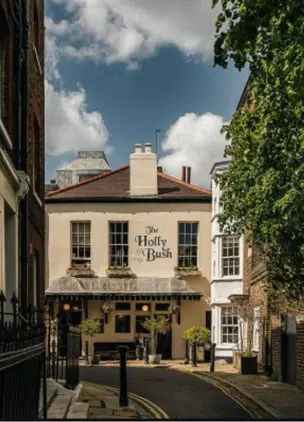
Up a quiet Hampstead backstreet, The Holly Bush began as the stables of artist George Romney’s house in the 1790s. The Victorian bar counter, wood panelling and ornate iron fireplace are all still in place. Order properly and stay longer than planned.
The difference usually comes down to what the hotel does with its history. Heritage hotels keep the original life of the building present, the weight of the staircase, the height of the ceiling, the details that belong to what the place was before. Cool hotels use the building as a starting point, layering design and atmosphere on top of it. Both are worth knowing. The choice usually depends on whether you want to feel inside history or simply surrounded by it.
Cool Hotels
Design-led stays with a stronger contemporary edge
Quiet Hotels
Calmer stays and a slower pace
Romantic Hotels in London
Softer light and more considered spaces
Our perspective
For collaborations and enquiries
We use cookies to improve your experience and understand how the site is used. You can accept or manage your preferences at any time.