Rooms with canal light, slower mornings and the city just outside.
Amsterdam’s canals are one of the few parts of the city that still feel exactly as they should. Four centuries on, they hold the shape of daily life, bicycles crossing over them, boats moving through them, light shifting against the houses they were built beside. Staying on the water changes the stay completely. It gives the trip a stronger sense of place, and a better view into how the city actually moves. If you are booking one of the better rooms in Amsterdam, a canal view is usually where to start.
Cool Hotels
Design-led stays with stronger identity
Jordaan
Quieter streets, local rhythm and smaller hotels
A canal-view room changes the stay in ways that are easy to underestimate. Amsterdam is a city built around water, and much of its character still plays out there, the light, the movement, the pace of the streets around it. Seeing that from your room gives the city a stronger presence, even in the quieter parts of the day. It is not essential, but it is one of the few upgrades that genuinely changes the experience. For a first stay, or a trip that matters a little more, it is often worth it.
These are the Amsterdam stays where the water shapes the room, the light and the pace of the stay.
Pulitzer keeps you inside the logic of the canal house, narrow, layered and inseparable from the water outside.
Set across twenty-five canal houses on the Prinsengracht and Keizersgracht, Pulitzer understands that the canal is not just the view, it is the structure of the stay. Rooms sit within the irregular width of old merchant houses, where the water shapes the light and the scale of everything around it. What makes it land is the contrast. Outside, the canal holds its constant movement. Inside, the gardens pull everything into quiet. Few hotels let you feel both sides of Amsterdam so clearly.
Canal-house stays, first visits, and travellers who want the city in its original form.
De L’Europe sits on the Amstel where Amsterdam opens up and the water carries more space around it.
The Amstel changes the stay immediately. Wider than the canals and less enclosed by the city, it gives De L’Europe a different relationship to water altogether, more open, less intimate, but stronger for it. Rooms hold longer sightlines across the river, with the city unfolding at a slower distance rather than pressing in close. Inside, the recent restoration keeps its older confidence intact, while Diptyque amenities and sharper detailing bring the experience forward without disturbing its weight.
River-facing stays, longer weekends, and travellers who want Amsterdam with more room around it.
Rosewood sits where the Prinsengracht slows down, and the stillness outside sharpens everything inside.
Set inside the former Palace of Justice, Rosewood carries unusual weight for a canal-side hotel, and that contrast is part of the appeal. The building’s civic scale remains intact, but the water outside softens its edges. From the rooms, the courtyard and Eeuwen downstairs, the Prinsengracht never disappears from view, holding a quieter presence than the busier stretches further north. Piet Boon’s renovation understood that balance well, allowing the canal to remain part of the architecture rather than simply the outlook.
Canal-side luxury, quieter stays, and travellers who want stillness with substance.
The Hoxton catches the canal at street level, social, loose and never fully separate from the city around it.
Set across five canal houses on the Herengracht, The Hoxton works because it never isolates itself from the street outside. The canal sits close to the rooms, but the life of the hotel stays just as present, coffee downstairs, dinner later, people passing through long after check-in. That overlap between hotel and neighbourhood is what makes it feel right here. The water is part of the stay, but never staged. It feels like Amsterdam as it is actually lived.
Social stays, canal-side weekends, and travellers who want the city still moving around them.
Adam’s strips canal-house Amsterdam back to its essentials, narrow walls, steep stairs and water just outside.
Set inside a sixteenth-century canal house, Adam’s keeps the original proportions doing most of the work. The rooms stay compact because the building asks them to, and that closeness gives the canal-facing stays a stronger sense of intimacy. Water, street and window sit almost within reach of each other, which is often how the canal belt works best. It is simpler than the larger names on this list, but more direct because of it. Less hotel, more house.
Short canal stays, smaller budgets, and travellers who want closeness over scale.
Max Brown gives you the canal belt without the ceremony, just good rooms, old timber and the water outside.
Set across three old canal houses on the Herengracht, Max Brown keeps the experience uncomplicated. The canal-facing rooms do not overplay the setting, but they do understand it, morning light off the water, slower streets below and the quiet repetition of canal life carrying on outside. Books, record players and worn timber keep the interiors grounded, giving the whole stay warmth without polish. For this address, and at this price point, it remains one of the easier ways into canal-house Amsterdam.
Affordable canal stays, shorter weekends, and travellers who want the water without the weight.
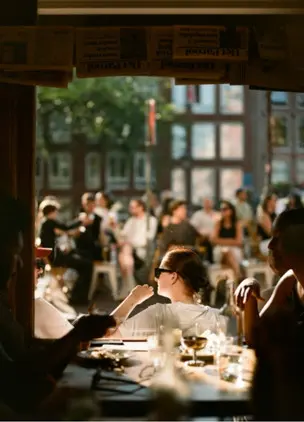
Right on the Prinsengracht, Café Twee Prinsen is one of those canal-side spots that makes sense the moment you sit down. The terrace catches the afternoon sun, the stools fill fast, and the whole place settles into that easy early-evening rhythm Amsterdam does well. Inside, it stays simple, wood panels, good bottles, small plates, and a room that feels properly local.
A canal-view stay and the Jordaan often overlap, but they offer different ways into Amsterdam. A canal-view hotel gives you the city’s best vantage point, water outside the window, light moving through the day, and a stronger sense of the city’s original shape. The Jordaan trades that for neighbourhood life, smaller streets, local cafés and a more residential rhythm. If the room matters more, stay on the water. If the streets matter more, stay in the Jordaan.
Jordaan
Smaller stays, quieter streets and neighbourhood life
De Pijp
Better food, busier streets and younger energy
Museum Quarter
Parkland, galleries and calmer city stays
Cool Hotels
Design-led stays with stronger identity
Our perspective
For collaborations and enquiries
We use cookies to improve your experience and understand how the site is used. You can accept or manage your preferences at any time.